Enterprise AI Architecture • SEO-Optimized Guide
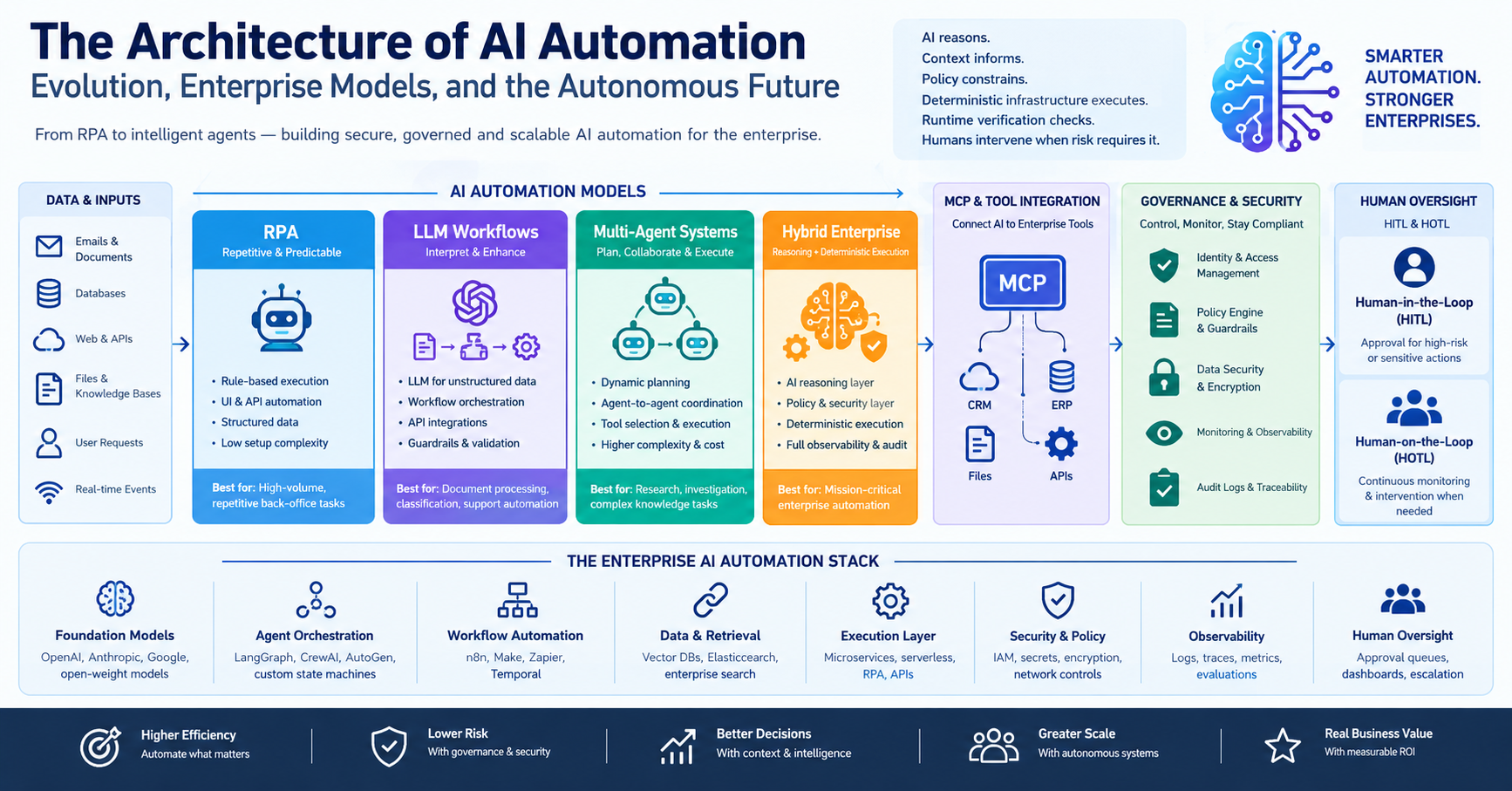
AI automation is moving beyond simple workflow triggers and rule-based robotic process automation (RPA). Modern enterprise systems can interpret unstructured information, retrieve organizational context, reason over business objectives, select approved tools, execute actions, verify results, and escalate exceptions to humans.
This evolution creates a new architectural question for organizations: where should AI reasoning sit within the automation stack?
The answer is rarely “replace everything with autonomous agents.” In production environments, the strongest architecture typically combines probabilistic AI reasoning with deterministic execution, explicit security policies, runtime verification, observability, and human oversight.
1. Foundational Landscape: What Is AI Automation?
AI automation is the use of artificial intelligence to interpret information, make bounded decisions, coordinate actions, and automate business processes that previously required manual judgment.
Traditional automation generally follows: Trigger → Rule → Action.
AI automation can instead operate as: Input → Context → Interpretation → Reasoning → Approved Action → Verification.
A production-grade AI automation architecture normally includes AI models, context and retrieval systems, workflow orchestration, tool and API integration, authentication and authorization, policy enforcement, validation, monitoring, human escalation, and audit logging.
The core architectural principle is simple: use AI where interpretation and reasoning create value, and use deterministic systems where predictable execution and control matter most.
2. The Evolution of Enterprise Automation
Enterprise automation has developed through several architectural stages.
2.1 Deterministic Rule Engines
Early business automation depended heavily on explicit rules and process definitions.
IF invoice_status = “approved” AND amount < $5,000 THEN process_payment ELSE send_for_review
Every meaningful condition had to be defined in advance. This provides excellent predictability but becomes difficult to maintain as the number of possible conditions grows.
2.2 Robotic Process Automation
Robotic Process Automation expanded automation into repetitive human-computer interactions. RPA platforms can interact with enterprise applications, websites, desktop software, spreadsheets, databases, and APIs.
RPA is particularly useful when the process is repetitive and predictable. Its limitation is that traditional RPA does not inherently understand the meaning of arbitrary information. A standardized invoice may be processed successfully while an unusual email containing ambiguous instructions may require human intervention.
3. The LLM Revolution: Cognitive Processing
Large language models introduced a new capability: machines can process large amounts of natural language and other unstructured information.
This makes it possible to automate tasks involving emails, contracts, customer conversations, technical documents, support tickets, reports, meeting transcripts, and natural-language instructions.
A common enterprise architecture is: Unstructured Input → LLM → Structured Data → Validation → Business Rules → Enterprise API → Verification.
The important distinction is that the LLM does not necessarily execute the transaction. Deterministic application logic can verify whether the order exists, the customer is eligible, the action complies with policy, and the user is authorized.
4. From AI Workflows to Agentic AI
The next stage is agentic AI. A conventional AI workflow follows a predetermined sequence. An agentic system can receive an objective and dynamically determine how to accomplish it.
An agent may search a knowledge base, retrieve customer information, inspect previous tickets, query an order-management system, compare evidence, generate a recommendation, validate it, execute an approved action, and record the result.
This creates the architecture: Goal → Planning → Tool Selection → Execution → Observation → Replanning.
The advantage is flexibility. The risk is that AI participates in decisions previously hard-coded. Autonomous AI therefore requires stronger controls around tool permissions, state, validation, cost, security, monitoring, termination, and human escalation.
5. Architectural Comparison of AI Automation Models
The four core paradigms represent different balances between deterministic control and probabilistic reasoning.
6. Robotic Process Automation: Reliability Through Constraint
RPA remains highly effective when processes have stable inputs, predictable rules, high transaction volumes, structured data, and limited decision complexity.
The problem occurs when the real-world process becomes unpredictable. A workflow designed around a specific website layout can fail when the interface changes. RPA therefore provides strong execution reliability when the process itself is stable.
7. LLM-Augmented Deterministic Workflows
This architecture is one of the most practical approaches to enterprise AI automation. Platforms such as n8n, Make, Zapier, and custom API-based systems can connect AI models to existing business infrastructure.
The AI handles the cognitive component while deterministic automation handles the transaction. This avoids giving the model unrestricted control over enterprise systems.
8. Autonomous Multi-Agent Frameworks
Frameworks such as LangGraph, CrewAI, and AutoGen provide abstractions for systems where multiple AI components collaborate.
A possible architecture includes a supervisor, research agent, analysis agent, execution agent, and validator.
The benefit is specialization. The cost is complexity: more model calls, higher latency, higher inference costs, additional state management, more failure points, and more difficult debugging. Multi-agent architecture should be used because task decomposition genuinely improves the system, not simply because multiple agents are fashionable.
9. The Hybrid Enterprise AI Architecture
For many organizations, the most practical long-term model is a hybrid architecture.
AI provides interpretation, planning, classification, reasoning, summarization, and decision recommendations. The deterministic layer provides authentication, authorization, business rules, API execution, transaction controls, validation, and auditability.
The key separation is: the AI can recommend what should happen, while the control plane determines what is permitted to happen.
10. Multi-Agent Orchestration and the Autonomous Enterprise
The future of AI automation is increasingly moving toward coordinated systems rather than isolated assistants. A supervisor agent may delegate work to specialized components responsible for research, data analysis, coding, compliance, customer support, retrieval, or execution.
Autonomous orchestration should be engineered like a distributed system. Architects need to define state management, message formats, retry policies, timeouts, idempotency, termination conditions, permission boundaries, cost limits, and failure recovery.
11. Model Context Protocol and AI Tool Integration
The Model Context Protocol (MCP) represents an important direction for standardized AI-to-tool connectivity.
Conceptually: AI Application → MCP Client → Tool / Context Servers → CRM, Files, Database, APIs.
Standardized connectivity can simplify how AI applications discover and interact with external capabilities. However, exposing a tool to an AI model does not mean the model should have unrestricted permission to use it.
Enterprise MCP deployments should apply authentication, authorization, least privilege, input validation, rate limiting, audit logging, data isolation, and explicit side-effect controls.
12. From Prompt Engineering to Context Engineering
Early AI implementations concentrated heavily on prompt engineering. Modern enterprise AI requires a broader discipline: context engineering.
The model’s operating environment can include system instructions, user requests, retrieved documents, database records, conversation history, current application state, tool definitions, organizational policies, user permissions, and previous actions.
A model cannot compensate for stale, incomplete, contradictory, or unauthorized information simply through better prompting. Context engineering is therefore a core enterprise AI discipline.
13. Governance-by-Design
AI governance should exist inside the architecture rather than only inside organizational documentation.
A mature AI automation platform should be able to answer: What information did the model receive? Which model version was used? Which tools were available? Which tools were called? What decision was generated? Which policy authorized the action? Was human approval required? What happened after execution?
This produces an auditable chain: Input → Context → Model → Decision → Policy → Tool → Result.
14. Human-in-the-Loop vs. Human-on-the-Loop
Human-in-the-Loop (HITL) requires a person to approve a consequential action. It is appropriate for large financial transactions, legal approvals, contract execution, privileged infrastructure changes, sensitive customer decisions, and high-impact account changes.
Human-on-the-Loop (HOTL) allows the system to operate autonomously while humans supervise performance. This is more scalable but requires strong monitoring and automated safety controls.
The appropriate level of human oversight should depend on impact, probability, reversibility, and detectability.
15. Runtime Verification and Execution Drift
One of the most underestimated problems in autonomous AI systems is execution drift. An AI workflow that worked correctly six months ago can behave differently after changes to models, prompts, retrieval data, APIs, tool definitions, business policies, or user behavior.
Runtime verification should test whether the result satisfies explicit invariants. For example: IF payment > $10,000 THEN human approval is mandatory.
These constraints should exist outside the LLM. Model reasoning, policy authorization, deterministic execution, and monitoring should remain distinct responsibilities.
16. Security Risks in Autonomous AI Automation
Autonomous systems introduce several new attack surfaces: prompt injection, indirect prompt injection, excessive agency, tool abuse, sensitive-data exposure, data poisoning, and credential exposure.
The most effective defense is architectural: least privilege, isolation, validation, policy enforcement, monitoring, and auditability.
17. What Does AI Automation Cost?
The economics of AI automation differ significantly from traditional scripts.
A deterministic automation may have high initial development cost and low execution cost. An LLM-based automation may have lower development cost for cognitive tasks but recurring inference and infrastructure costs.
Enterprise cost analysis should include model inference, embeddings, retrieval, tool calls, infrastructure, evaluation, testing, monitoring, context management, security, human escalation, failed transactions, latency, incident investigation, and token consumption.
ROI should be measured using cost per successful transaction, human hours eliminated, error-rate reduction, resolution time, automation coverage, escalation rate, revenue impact, and incident cost.
18. Enterprise AI Automation Technology Stack
A production AI automation platform can contain foundation models, agent orchestration, workflow automation, tool integration, data and retrieval systems, execution infrastructure, policy engines, observability, security, and human oversight.
The most important point is that an agent framework alone does not constitute an enterprise AI architecture. The difficult engineering problems usually involve state, security, permissions, evaluation, observability, governance, and failure recovery.
19. Frequently Asked Questions About AI Automation
| Architecture | Logic Execution | Unstructured Data | Setup | Reliability Risk | Ideal Use Case |
| RPA | Fixed rules, workflows, UI/API actions | Limited–Moderate | Low–Medium | Low model risk; brittle assumptions | Repetitive back-office operations |
| LLM + Deterministic Workflow | Workflow engine + LLM + predefined APIs | Strong | Medium | Moderate; reduced by validation | Documents, support, classification |
| Autonomous Multi-Agent | Dynamic planning and agent coordination | Very strong | High | High without strict controls | Research and complex knowledge tasks |
| Hybrid Enterprise | AI reasoning + policy + deterministic execution | Strong | High | Controlled through verification | Mission-critical enterprise automation |
What is the difference between standard RPA and AI automation?
Standard RPA primarily executes predefined workflows and rules. AI automation can additionally interpret unstructured information, reason over context, and make bounded decisions. RPA is particularly effective for predictable processes, while AI automation becomes useful when workflows contain ambiguity, natural language, documents, or contextual decision-making.
Can agentic AI automation run safely without human intervention?
Yes, for appropriately bounded tasks. Safe autonomous operation requires controlled permissions, validation, monitoring, transaction limits, termination conditions, audit logging, and escalation mechanisms. The more consequential or irreversible the action, the stronger the required controls should be.
What is the true cost and ROI of moving from scripts to AI agents?
AI agents can reduce development effort for complex cognitive workflows, but they introduce recurring model, infrastructure, monitoring, evaluation, and operational costs. ROI should be calculated using cost per successful task, human labor saved, error reduction, processing time, automation coverage, revenue impact, and escalation rate.
What security vulnerabilities are introduced by autonomous AI workflows?
Major risks include prompt injection, indirect prompt injection, excessive permissions, tool abuse, sensitive-data exposure, data poisoning, credential leakage, and uncontrolled autonomous execution. These risks require architectural controls rather than relying solely on better prompts.
Which tools and technology stacks are required to build enterprise AI automation?
A typical stack includes a foundation model, orchestration layer, workflow engine, API/tool layer, retrieval system, policy engine, observability platform, security infrastructure, and human approval mechanisms. Exact choices depend on data, compliance, workload, latency, and risk requirements.
Conclusion: The Architecture Behind the Autonomous Future
AI automation is progressing from deterministic workflow execution toward cognitive and goal-driven systems.
RPA remains valuable for predictable processes. LLM-augmented workflows provide a practical bridge between traditional automation and AI reasoning. Multi-agent architectures introduce dynamic planning and task decomposition. Hybrid enterprise architectures combine these capabilities with deterministic execution and governance.
The emerging enterprise model can be summarized as:
AI reasons. Context informs. Policy constrains. Deterministic infrastructure executes. Runtime verification checks. Humans intervene when risk requires it.
The future of AI automation is therefore not simply about creating agents that can perform more tasks. It is about creating systems that can perform more tasks without losing control, observability, security, or economic discipline.
That is the architectural foundation required for moving AI automation from experimental prototypes into reliable enterprise infrastructure.


