Apple Ecosystem & Smart Home Fixes: How to Fix HomeKit No Response
You tap a Home app tile expecting the lights to come on. Instead, you get the message every smart-home owner eventually learns to dislike: “No Response.”
I’ve seen this happen even when everything looks perfectly normal. The Wi-Fi is working, the iPhone is online, and the smart accessory was responding perfectly yesterday. Yet HomeKit suddenly acts as if the device has disappeared.
The good news is that a HomeKit “No Response” error usually has a logical cause. It may be a network problem, a Home Hub issue, an accessory that has lost its connection, or simply a device that needs a restart.
In this guide, I’ll walk through the most reliable ways to fix HomeKit no response problems, starting with the quickest solutions and moving toward more advanced troubleshooting.
Why Does HomeKit Say “No Response”?
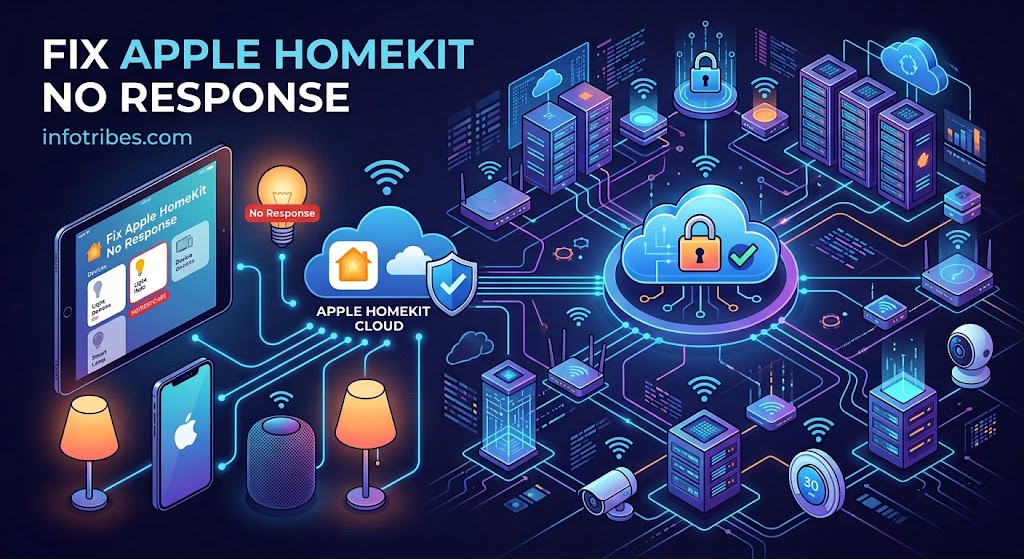
HomeKit relies on several pieces working together. Your iPhone or iPad communicates with Apple’s Home framework, your home network connects compatible accessories, and a Home Hub can help keep your smart home available when you’re away.
If one part of that chain stops communicating properly, the Home app may display “No Response.”
Common causes include:
• Wi-Fi connectivity problems
• A smart accessory losing power
• Router or mesh-network issues
• An Apple Home Hub experiencing problems
• Bluetooth interference or range limitations
• An accessory firmware problem
• Incorrect network configuration
• A temporary Home app or iCloud synchronization issue
• An accessory that needs to be reset and paired again
Start with the simplest possible fix.
1. Check Whether One Device or Several Devices Are Affected
Before changing any settings, look at your Home app. Is one accessory showing “No Response,” or are several devices unavailable?
If only one accessory is affected, the problem is probably local to that device. If many accessories are affected, look at your network and Apple Home setup first.
Think network-wide before device-specific.
Tech & Sports Tip: Setting up your HomeKit smart TV or Apple TV to stream live matches effortlessly? If you want to stay updated with the latest match analysis and news, check out our dedicated Sports News Portal for in-depth coverage.
2. Make Sure the Accessory Has Power
This sounds almost too obvious, but it is one of the first things I check.
A smart bulb can be unreachable because someone turned off the physical wall switch. A smart plug can be offline because it was unplugged. Check for status LEDs, loose cables, tripped breakers, battery warnings, and disconnected power adapters.
If the accessory has no signs of power, fix that before touching your HomeKit settings.
3. Restart the Problem Accessory
A simple reboot can clear surprisingly stubborn HomeKit problems.
If the manufacturer provides a normal restart procedure, use that first. Give the device a few moments to reconnect before checking the Home app again.
Don’t immediately reset the accessory to factory defaults. A restart and a factory reset are very different things.
4. Check Your Wi-Fi Connection
HomeKit accessories that depend on Wi-Fi need a stable connection to communicate with the rest of your smart home.
Start by checking whether your iPhone is connected to the expected home network. Then test another device on the same network.
Your internet connection can be working while communication between devices on your home network is failing.
5. Restart Your iPhone or iPad
The Home app itself can occasionally get into a strange state.
If the accessory appears online elsewhere but Home still reports No Response, restart the Apple device you’re using to control your home.
After restarting:
1. Open the Home app.
2. Wait for accessories to load.
3. Try the affected accessory.
4. Check whether its status changes.
6. Check Your Apple Home Hub
A Home Hub helps Apple manage your home and allows remote access and automation features to work properly.
Depending on your setup, an Apple TV or HomePod can serve as a Home Hub.
Check whether your Home Hub is available, connected to your home network, powered on, and running current software.
7. Restart Your Home Hub
If your Home Hub appears to be the source of the problem, restart it using the normal Apple-supported procedure.
Afterward, give the system a little time to settle. Don’t repeatedly restart every device at once, because changing several things simultaneously makes troubleshooting harder.
8. Check for Software and Firmware Updates
Smart-home reliability can depend heavily on software compatibility.
Check your Apple devices for available software updates. You should also check whether the manufacturer has released firmware updates for the affected accessory.
Updates can address connectivity bugs, HomeKit compatibility problems, security issues, stability problems, and communication failures between accessories and hubs.
9. Check Whether Your Router Is Blocking Local Communication
Some router settings can interfere with communication between smart-home accessories and Apple devices.
Pay particular attention to client isolation, AP isolation, guest networks, VLAN separation, multicast filtering, firewall rules, and device-to-device communication restrictions.
A smart accessory connected to a guest network may not be able to communicate properly with your primary Apple devices.
10. Check the Accessory’s Manufacturer App
Many HomeKit-compatible accessories also have their own apps.
If an accessory isn’t responding in Apple Home, open the manufacturer’s app and see whether the device is reachable there.
If the manufacturer’s app also can’t reach it, the problem is probably related to the accessory, network, or manufacturer service. If the manufacturer’s app works but Apple Home doesn’t, the HomeKit connection or Apple Home configuration may need attention.
If you frequently save smart home setup video guides, tutorials, or troubleshooting clips from TikTok for offline viewing, you can quickly save them using our TikTok Downloader Tool.
11. Remove and Re-Add the Accessory Carefully
If you’ve tried the basic troubleshooting steps and one accessory still refuses to respond, removing and re-adding it may help.
Treat this as a later step. Before removing anything, check whether the accessory contains settings that you’ll need to recreate, including room assignments, automations, scenes, accessory names, schedules, and manufacturer-specific settings.
12. Don’t Reset Your Entire Smart Home Too Quickly
One device stops responding, and the immediate reaction can be to delete the Home, reset the router, factory-reset every accessory, and start again. That’s rarely the best first move.
A better troubleshooting sequence is:
1. Identify the scope of the problem.
2. Check the accessory’s power.
3. Restart the accessory.
4. Check Wi-Fi.
5. Restart the controlling Apple device.
6. Check the Home Hub.
7. Restart the Home Hub if necessary.
8. Check software and firmware.
9. Investigate router configuration.
10. Re-pair the affected accessory only if needed.
HomeKit “No Response” Troubleshooting by Symptom
One accessory says “No Response” → Check power, accessory connection, and the manufacturer app.
Several accessories say “No Response” → Check the router, Wi-Fi, and Home Hub.
Everything works at home but not remotely → Check the Home Hub and network connection.
Accessory disappears repeatedly → Check Wi-Fi signal, mesh network, and firmware.
Accessory works in manufacturer app but not Home → Check HomeKit pairing/configuration.
Devices stopped working after router changes → Check network settings and device connectivity.
Problem started after an update → Check software/firmware compatibility.
The pattern matters. One broken accessory is usually a different problem from an entire broken smart home.
What If HomeKit Says “No Response” After a Router Change?
Router upgrades are a common source of smart-home headaches.
If this happens, check the Wi-Fi network name, Wi-Fi password, security mode, guest-network configuration, device isolation, mesh settings, local network communication, and whether accessories need to be reconnected.
If you changed both the router and Wi-Fi credentials, don’t assume every accessory will automatically adapt.
What If Only One HomeKit Accessory Keeps Going Offline?
If every other device works reliably, focus on that individual accessory.
Try this order:
Step 1: Confirm that it has power.
Step 2: Restart it.
Step 3: Check the manufacturer’s app.
Step 4: Check its wireless connection.
Step 5: Update its firmware if an update is available.
Step 6: Restart the router or relevant mesh node if connectivity appears questionable.
Step 7: Remove and re-add the accessory if the problem persists.
If the same accessory repeatedly becomes unavailable after being re-added, the hardware itself may be the problem.
What If All HomeKit Devices Say “No Response”?
When everything goes offline at once, investigate the shared infrastructure first.
Check these in order:
1. Router
2. Wi-Fi network
3. Home Hub
4. Apple Home status
5. Internet/local-network connectivity
6. Recent network or software changes
If your iPhone can browse the internet but your smart-home devices can’t communicate with one another, pay special attention to the router’s local-network configuration.
How to Prevent Future HomeKit Problems
Fixing the current problem is only half the job.
Keep your network configuration stable. Avoid changing Wi-Fi names and passwords unless there’s a good reason.
Keep important Apple devices updated. Updates aren’t guaranteed to solve every HomeKit problem, but keeping your ecosystem reasonably current reduces compatibility issues.
Give your smart home a simple structure. Use clear room names and descriptive accessory names.
Document complicated automations. If you have dozens of scenes and automations, keep a simple record of the important ones.
A Quick HomeKit No Response Checklist
☐ Is the accessory powered on?
☐ Is only one device affected?
☐ Is your iPhone connected to the correct Wi-Fi network?
☐ Does the manufacturer’s app see the accessory?
☐ Have you restarted the accessory?
☐ Have you restarted your iPhone or iPad?
☐ Is your Home Hub online?
☐ Have you restarted the Home Hub?
☐ Is your router working correctly?
☐ Did you recently change your Wi-Fi settings?
☐ Are guest-network or isolation settings enabled?
☐ Are Apple devices and accessories updated?
☐ Have you tried removing and re-adding only the affected accessory?
When Should You Factory Reset a HomeKit Accessory?
A factory reset should be one of the last steps, not the first.
Consider it when:
• The accessory consistently fails after normal troubleshooting.
• The manufacturer recommends a reset.
• The accessory cannot be paired normally.
• Its existing HomeKit configuration appears corrupted.
• You have already confirmed that the network itself is functioning.
Factory-reset procedures vary considerably between brands and product types. A factory reset can erase configuration you’ve spent time creating.
Final Thoughts
When HomeKit displays “No Response,” the problem isn’t necessarily serious.
In many cases, the fix is surprisingly simple: restore power, restart the accessory, reconnect the network, or get the Home Hub communicating again.
The key is to troubleshoot systematically rather than resetting everything at once.
I recommend starting with the smallest possible change and expanding your investigation only when the evidence points toward a larger problem. That approach saves time, protects your existing automations, and makes it much easier to identify the real cause.
If you’ve found another reliable way to fix HomeKit no response problems, what worked for your setup? Share your solution in the comments — it might save another smart-home owner an afternoon of frustration.