
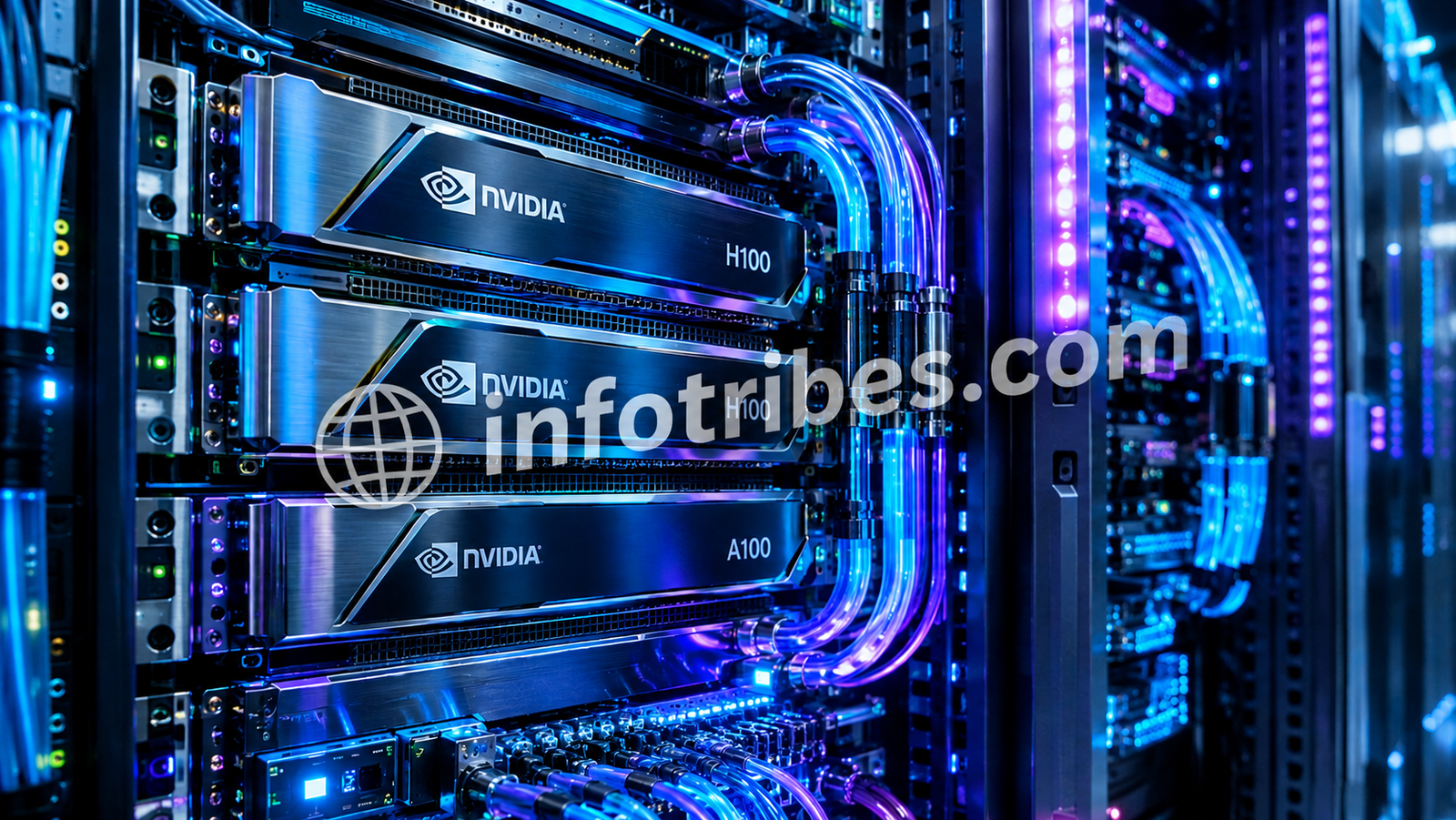
In the modern landscape of artificial intelligence, machine learning, and large-scale data processing, hardware bottlenecks are the ultimate killer of momentum. Training a 70-billion-parameter Large Language Model (LLM) or running complex real-time molecular dynamics simulations on standard CPU instances or legacy GPU instances is not just inefficient—it is cost-prohibitive and painfully slow.
To maintain a competitive edge, technology enterprises, AI research organizations, and data engineering teams are rapidly shifting toward enterprise-grade infrastructure built around high-performance GPU cloud hosting.
By tapping into cloud-native compute clusters powered by NVIDIA’s flagship Hopper (H100) and Ampere (A100) architectures, businesses can bypass massive upfront capital expenditures while gaining instant access to petascale floating-point performance.
This comprehensive guide breaks down everything you need to know about selecting, architecting, and optimizing high-performance GPU cloud hosting solutions for enterprise workloads.
| 📋 Executive Summary & Key Takeaways • Unmatched Compute Density: NVIDIA H100 Tensor Core GPUs deliver up to 3x to 6x performance gains over A100 GPUs for transformer-based LLM training and inference thanks to dedicated Transformer Engines. • Architectural Precision: NVIDIA A100 remains the industry gold standard for general-purpose deep learning, HPC simulations, and budget-conscious AI training environments. • Scalability & Interconnects: Maximum throughput relies as much on high-speed networking (NVIDIA Quantum-2 InfiniBand at 3200 Gbps) as it does on raw GPU compute power. • Cost Optimization: Leveraging spot instances, reserved instance commitments, and bare-metal multi-instance GPU (MIG) slicing can lower cloud infrastructure expenditures by 40% to 70%. |
1. The Evolution of Compute: Why GPU Cloud Hosting Matters
Central Processing Units (CPUs) are engineered for sequential processing—executing complex series of tasks with low latency. However, artificial neural networks, 3D ray tracing, and massive matrix math operations require massive parallelism.
A modern deep neural network executes billions of matrix multiplications simultaneously. GPUs, built with thousands of small cores optimized for concurrent mathematical calculations, represent the core hardware engine driving this technological shift.
When managing state-of-the-art AI development, purchasing physical hardware poses significant challenges:
• Supply Chain Delays: Sourcing physical server nodes populated with NVIDIA H100 SXM5 modules often incurs long procurement lead times.
• Thermal & Power Constraints: A single 8x H100 server chassis draws upwards of 10.2 kW of power, requiring liquid cooling and specialized data center infrastructure.
• Capital Depreciation: Cutting-edge accelerator chips undergo rapid generational shifts every 18 to 24 months.
Adopting high-performance GPU cloud hosting transforms heavy CapEx infrastructure expenditures into predictable OpEx cloud spending. It affords instantaneous scaling, global availability, and immediate access to pre-configured NVIDIA CUDA, TensorRT, and PyTorch environments.
2. Architectural Deep-Dive: NVIDIA H100 vs. NVIDIA A100
Choosing the correct hardware acceleration tier requires a clear understanding of the architectural distinctions between NVIDIA’s Ampere and Hopper microarchitectures.
| Feature | NVIDIA A100 (Ampere) | NVIDIA H100 (Hopper) |
| Architecture | Ampere (7nm TSMC) | Hopper (4nm TSMC Custom) |
| Memory Bandwidth | Up to 2.0 TB/s (HBM2e) | Up to 3.35 TB/s (HBM3) |
| FP8 Precision | Not Supported (Native) | Supported (3,958 TFLOPS) |
| Interconnect (NVLink) | 600 GB/s | 900 GB/s |
| Transformer Engine | No | Yes (Dynamic FP8/FP16 Selection) |
The NVIDIA A100 Tensor Core GPU: The Workhorse of Modern AI
Built on TSMC’s 7nm process, the NVIDIA A100 introduced structural sparsity and Multi-Instance GPU (MIG) technology to enterprise computing.
• Multi-Instance GPU (MIG): Enables a single A100 GPU (80GB) to be partitioned into up to seven fully isolated GPU instances. Each partition possesses its own high-bandwidth memory, cache, and compute cores, making it ideal for multi-tenant microservices or lower-throughput inference tasks.
• Third-Generation Tensor Cores: Delivers massive acceleration for FP32, TF32, FP16, INT8, and INT4 precision formats.
The NVIDIA H100 Tensor Core GPU: Built for Generative AI
Built on a customized TSMC 4nm process, the H100 Hopper architecture represents a massive leap forward in compute capacity, specifically tailored for LLMs and foundational models.
• Transformer Engine: Automatically dynamically adjusts precision between 8-bit floating-point (FP8) and 16-bit (FP16) during training and inference. This speeds up processing without sacrificing model convergence or output accuracy.
• Fourth-Generation NVLink: Delivers 900 GB/s bidirectional bandwidth per GPU, enabling seamless scale-out across 256-GPU cluster blocks (NVLink Switch System).
• DPX Instructions: Specialized instruction sets that accelerate dynamic programming algorithms by up to 7x compared to previous generations, vastly improving spatial alignment and route planning algorithms.
Selecting high-performance GPU cloud hosting equipped with H100s reduces model training times from weeks to days for models exceeding 100 billion parameters.
3. Key Infrastructure Pillars for Enterprise GPU Cloud Deployment
Deploying compute-bound workloads requires more than just isolated GPU chips. The surrounding network, storage, and orchestration infrastructure must be tuned to prevent performance bottlenecks.
1. Inter-Node Networking (InfiniBand vs. RoCE v2)
When executing distributed data-parallel or tensor-parallel training across hundreds of GPUs, networking speeds become critical.
• InfiniBand (NVIDIA Quantum-2): Offers up to 3200 Gbps throughput with extremely low latency and zero packet loss. Essential for supercomputing clusters.
• RoCE v2 (RDMA over Converged Ethernet): An enterprise Ethernet alternative that enables Direct Memory Access over IP networks, striking a balance between cost and high throughput.
2. High-Throughput Storage & GPUDirect Storage (GDS)
Standard disk I/O introduces CPU-bound bottlenecks. Modern high-performance GPU cloud hosting incorporates GPUDirect Storage (GDS). GDS establishes a direct DMA path between NVMe drive arrays and GPU HBM memory, bypassing host CPU bounce buffers and cutting transfer latencies by up to 10x.
3. Orchestration & Container Support
Leading cloud platforms provide pre-built Docker container environments integrated with NVIDIA Container Toolkit (nvidia-docker), Kubernetes Orchestration (K8s with GPU Operators), and Slurm Workload Manager for traditional HPC batch scheduling
4. Real-World Benchmark Comparisons & Workload Matching
To select the right instance type on high-performance GPU cloud hosting platforms, consider these benchmark insights across primary industry use cases:
| Workload Profile | Preferred GPU Model | Optimal Scaling Setup |
| LLM Pre-Training (>13B Params) | NVIDIA H100 SXM5 | 64x to 512x H100 Cluster |
| Fine-Tuning (LoRA / QLoRA) | NVIDIA A100 (80GB) | 2x to 8x A100 PCIe/SXM |
| Real-Time LLM Inference | NVIDIA H100 (FP8) | Single/Dual H100 Node |
| Computer Vision & Image Gen | NVIDIA A100 / L40S | 1x to 4x GPU Node |
| High-Performance Computing (HPC) | NVIDIA A100 / H100 | InfiniBand Interconnected |
Deep Learning & Large Language Model (LLM) Training
For models built on transformer architectures (e.g., Llama-3, Mistral, GPT-4 scale implementations), the H100’s native FP8 precision delivers up to 6x faster training throughput compared to an A100 operating on FP16.
Enterprise Inference at Scale When deploying models into production environments where sub-50ms token generation latency is required, the H100’s high HBM3 memory bandwidth (3.35 TB/s) prevents memory-bandwidth-bound delays, processing up to 300% more inference requests per dollar compared to previous generations.
5. Cost Optimization Strategies for Scale-Out Infrastructure
Deploying top-tier hardware clusters requires active financial governance. Without proper management, cloud GPU charges can scale rapidly.
Here are four strategies to keep cloud spending efficient:
1. Leverage Multi-Instance GPU (MIG) Partitions: Avoid dedicating an entire 80GB A100 or H100 instance to lightweight tasks like preprocessing or low-traffic API hosting. Partition the card into smaller MIG instances to maximize utilization across teams.
2. Utilize Spot / Preemptible Instances for Fault-Tolerant Training: Unused provider capacity is often heavily discounted (up to 60-70% off on-demand rates). Use automated checkpointing (e.g., PyTorch Lightning or PyTorch DeepSpeed checkpoints saved every 15 minutes to object storage) to safely run training runs on preemptible GPU instances.
3. Reserved Instances & Committed Use Contracts: If your baseline workload runs continuously year-round, entering into 1-year or 3-year committed-use agreements with specialized GPU cloud providers can significantly reduce hourly costs compared to standard pay-as-you-go rates.4. Right-Sizing Precision (FP8 / INT8 Quantization): Optimize models before expanding cluster capacity. Using FP8 quantization on H100 instances cuts memory overhead by half, allowing larger batch sizes per card and reducing the total hardware count needed.
6. Step-by-Step Guide: Deploying an H100/A100 Cluster
Follow this operational framework to launch, verify, and run production workloads on high-performance GPU cloud hosting environments.
Step 1: Provisioning the Instance
Select a provider offering bare-metal or cloud-native pass-through instances running Ubuntu 22.04 LTS equipped with NVIDIA H100 SXM5 or A100 80GB modules.
Step 2: Driver & CUDA Verification
Once SSH connection is established, verify that the system detects all hardware acceleration devices and correct driver versions:
| # Verify GPU driver detection and operational health nvidia-smi |
Step 3: PyTorch CUDA Access Verification
Validate that Python execution frameworks correctly access the compute fabric:
| import torch print(f”CUDA Available: {torch.cuda.is_available()}”) print(f”Device Count: {torch.cuda.device_count()}”) for i in range(torch.cuda.device_count()): print(f”Device {i}: {torch.cuda.get_device_name(i)}”) print(f”Memory Overhead: {torch.cuda.get_device_properties(i).total_memory / 1e9} GB”) |
Step 4: Distributed Workload Execution
Launch multi-GPU distributed training using torchrun across interconnected compute blocks:
| torchrun \ –nproc_per_node=8 \ –nnodes=1 \ –node_rank=0 \ –master_addr=”127.0.0.1″ \ –master_port=29500 \ train_llm.py –batch_size 32 –precision fp8 |
“Streamlining your architecture through proper cloud infrastructure migration management ensures smooth integration with high-performance GPU clusters.”
7. Frequently Asked Questions (FAQs)
Q1: What is the primary difference between NVIDIA H100 PCIe and H100 SXM5 modules in cloud hosting environments?
The primary differences lie in power consumption, interconnect speed, and total performance. The H100 PCIe variant operates at 350W-400W with NVLink speeds capped at 600 GB/s. The H100 SXM5 module operates at up to 700W, featuring full 900 GB/s NVLink bandwidth and direct integration with NVLink Switch Systems. This makes SXM5 the preferred choice for enterprise high-performance GPU cloud hosting clusters running large-scale LLM training.
Q2: Why is HBM (High Bandwidth Memory) critical for AI workloads?
Deep learning algorithms, particularly transformer models during inference, are frequently constrained by memory bandwidth rather than raw clock speed. High Bandwidth Memory (HBM2e on A100, HBM3 on H100) stacks DRAM dies vertically directly on the GPU substrate. This yields ultra-wide memory buses capable of transferring data at up to 3.35 TB/s, drastically reducing time spent waiting for model weights to load into compute logic cores.
Q3: Can I run high-performance GPU cloud hosting workloads across hybrid cloud environments?
Yes. Using containerization standards like Kubernetes combined with the NVIDIA GPU Operator, enterprise engineering teams can orchestrate training jobs seamlessly across on-premises clusters and cloud environments without modifying code structures.
Final Thoughts & Next Steps
Selecting the right high-performance GPU cloud hosting infrastructure is a core strategic decision for modern AI-driven organizations. While NVIDIA A100 instances remain a reliable, cost-effective choice for mainstream deep learning models, transitioning to NVIDIA H100 clusters provides the structural throughput, native FP8 precision, and NVLink scaling required to efficiently handle next-generation AI workloads. By aligning your infrastructure needs with workload demands, network interconnects, and cost-management frameworks, your team can accelerate training pipelines, run lower-latency inference, and maintain a competitive edge in AI development.